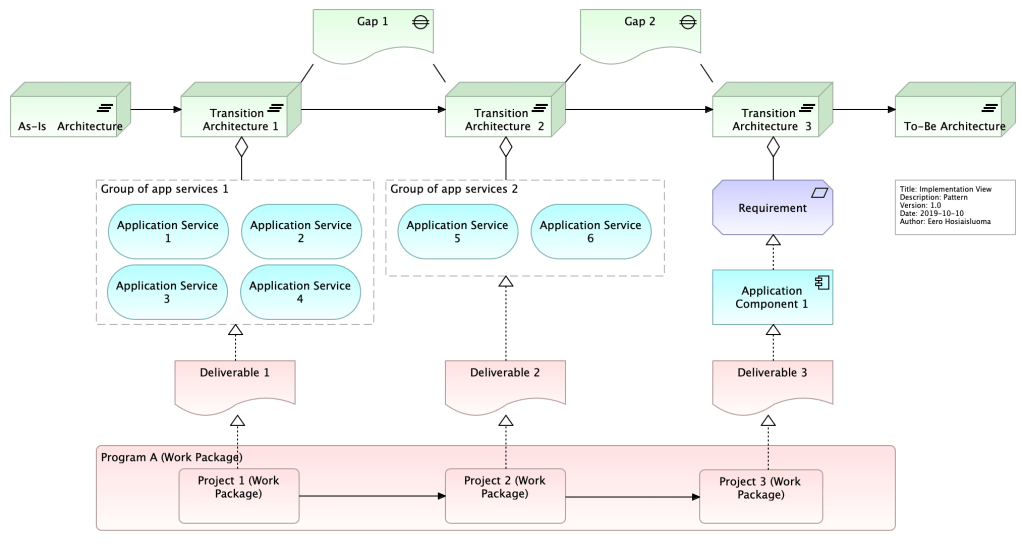
In my previous post I mentioned that Enterprise Architecture frameworks like TOGAF can empower you to design solutions that align with organizational goals, fostering agility and scalability. In this post I’d like to highlight how Business Analyst can use ArchiMate to deconstruct Business Architecture and use that information in a manner that can be consumed by an information system (or architecture repository) to be used by the enterprise at scale.
Businesses constantly seek ways to optimize processes, improve decision-making, and align their strategies with their objectives. Leadership is also concerned about capture, management, and retention of institutional knowledge. ArchiMate, a powerful modeling language, not only offers a standardized framework for modeling and visualizing enterprise architectures making it a valuable tool for business analysis, it also provides a standardized language and mechanisms to decompose knowledge into information so that this can be used to further utilized by others in and across the organization. In this blog post, we will explore how ArchiMate can be leveraged for effective business analysis in and enterprise context.
Business Architecture documents with ArchiMate
Modeling Business Architecture is the first step in modeling a comprehensive enterprise architecture information repository. Incorporating ArchiMate patterns into the business analysis practices (say to capture current processes) and project management practices (designing for future state) can be terrific contributors to the knowledge repo so long you maintain a standard for knowledge capture. Below a sample of diagrams and patterns by Eero Hosiaisluoma which can be incorporated into Business Requirement, Functional Requirement, Solution Architecture documents. Once the data points are collected in the documents, they can then serve as inputs into the repository.
Benefits of Using ArchiMate for effective Business Analysis
- Improved Clarity and Communication
ArchiMate’s standardized notation makes it easier to represent complex ideas and relationships in a clear and consistent manner. This clarity is essential for effective communication among stakeholders, ensuring everyone understands the proposed changes or strategies. Use ArchiMate elements like “Requirements”, “Actors”, “Roles” and “Business Processes” part of you documentation efforts. - Enhanced Decision-Making
Business analysis often involves evaluating different scenarios and their potential impacts. ArchiMate models facilitate scenario analysis by providing a visual representation of the current state and the proposed changes. This enables stakeholders to make informed decisions based on a deeper understanding of the architecture. - Traceability and Impact Analysis
One of ArchiMate’s strengths is its ability to differentiate structural vs dynamic relationships between different architectural elements. This feature allows business analysts to perform meaningful impact analysis, understanding how changes in one part of the architecture may or may not affect other areas. This is invaluable when assessing the consequences of business decisions or technology changes. - Alignment with Business Goals
ArchiMate allows you to link architecture elements to business goals and objectives. This alignment ensures that all architectural decisions contribute to the realization of the organization’s strategic vision, helping to maintain a clear line of sight from the business strategy to the implementation. - Scalability and Reusability
ArchiMate is scalable and can be adapted to different levels of detail, from high-level strategic views to detailed operational views. This flexibility makes it suitable for various business analysis tasks. Moreover, models created in ArchiMate can be reused and refined across different projects and initiatives, saving time and effort. - Open Standard
ArchiMate is a Standard promoted by The Open Group, which is supported a number of applications and diagramming solutions. With ArchiMate you also avoid vendor lock-in which store information in proprietary formats.




 Alberto D. Mendoza
Leave a comment